Fading colors


The colors roasting in the oven are the same as the ones fading outside my window. Red beets, orange sweet potatoes, green herbs softly turning brown.

Fall is here, and I am celebrating with a autumn breakfast, a harvest I did not plant, grow, or pick. My talents have always seemed to involve baking the bread to go on the side of the plate rather than coaxing the carrots to grow and claim their place in the center, so I rely on the skills of others.

The bacon now is sizzling on the stove. The sun has started to shine over the mountains, the leaves illuminated as they catch its rays, and my sons are beginning to rub sleep from their eyes. It is only morning, and already I long to hold onto this day, a day I did not create.

“We plant the seeds that one day will grow…. We are prophets of a future not our own.” These were the words written on the wall of the first home my husband and I shared together, painted by former residents to remind us that we do not have to do everything on our own. And that is our blessing – that we cannot.

I scrape the discarded peels into the compost bucket as news of the latest election scandal drones on in the background. This is my children’s world. What inheritance are we creating for them?

I am harvesting a world I did not plant and planting seeds I will not sow, hoping that one will yield more than the other.

A Blank Notebook

blank_pages_in_an_open_notebook_28481226915129

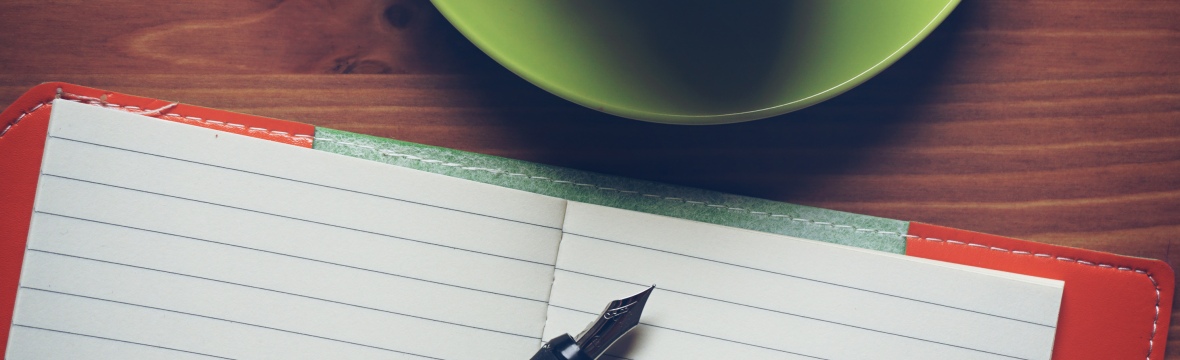
The earth is cooling off, and the evening sun has ceased burning well into the night. The air is beginning to smell like sweet apples. But there is one feeling I associate with fall more than any other – smoothing my hand across the cool, flat pages of a crisp and unused notebook. Back to school, back to beginning again.

***
The campus was beautiful and ancient, with brick paths leading to unknown futures. I sat nervously in classrooms full of students who surely seemed to know more than I did, and were doubtlessly better prepared. My class choices that first semester were ambitious, and I did not rise to the challenge. One month into the school year, my Ancient Greek professor pulled me aside and asked if I had enough hours to drop the course and remain enrolled. I did not.

“I suggest you not continue on with this course next semester,” she replied, pursing her lips together.

I struggled to memorize hundreds of oil paintings which all seemed to feature Jesus, Mary, and Joseph in various combinations, and filled in the wrong bubbles when being tested on a variety of psychological disorders. Letters appeared a top of my tests that I had never previously seen in that location before. I cried silently in the shower.

The semester slowly drew to a close, and I received my grade in Ancient Greek – a hearty C. I had passed, I had passed! I danced down the hall, running to hug a friend. Moments later it occurred to me that I might have embarrassed myself, bragging about my merely passing grade to classmates who would later on earn their JDs, MDs and PhDs from Ivy League institutions.

I made it home in one piece. A woman from my mother’s bible study ran up to me at church, “Oh how are you? We heard you were failing. We’ve been praying for you.”

***
Fliers around campus advertised open positions on the college newspaper. I averted my eyes, and tucked away my childhood dreams of becoming a writer. Surely they were looking for students whose GPAs would merit them a discount on car insurance. Not for me. I wouldn’t be good enough.

The next few years, my grades and my self esteem slowly ticked upwards. I realized I was better at discussing social stratification in prehistoric America and the impacts of immigration on non-western religions than I was at memorizing tenses and participles. I breathed a sigh of relief when a quick flip to the pack of a course syllabus revealed a final paper rather than an exam. The fear of failure lingered, however, and as the years till graduation melted away, it kept bubbling just below the surface.

***
“So what do you want to do?” my mother asked me, sitting on my bed as I unpacked, home from school my first year.

“What do you mean?” I asked, filling my drawers with t-shirts bearing the school’s name. “Like, when I grow up?”

She laughed. “No, in three years. When you graduate.”

I put a few more books on the bookshelf. I had no idea.

***
Graduate school and first jobs ticked by, and I received diplomas for the wall, paychecks for the bank, and handshakes for a job well done. But they never seemed to silence that nagging voice in my head, the one that kept saying, you probably aren’t good enough.  

Successes don’t quiet the fear, just as turning on the light in my son’s bedroom has never managed to convince him that there are not monsters hiding in the closet.

***
I’m thirty now, and my notebook is no longer crisp and clean, but has begun to fill with a few chapters and scratched out first drafts. In one of those chapters, I began came a mother, and oddly enough, having something I desperately wanted to write about for the first time made me worry less about if it was any good. I had a story that needed telling, even if I was the only one interested in reading it.

My son starts preschool next month, and I will wave goodbye to him with tears in my eyes, handing over the baton. My formal education has finished, with that one last walk across a stage when he was no more than a tiny bump under my black robe. His is just beginning. He will work his way from letters and numbers to the deep mysteries of the universe, joining the pursuit of scholars everywhere as they try to figure out what makes us tick.

You don’t need to know what you want to do, I want to tell him. You can start, stop, and start over again, if needed. You don’t have to do everything well. You don’t have to be the best. You have a blank notebook.

Just start writing.
Omran Daqneesh 

The story of the little Syrian boy, Omran Daqneesh, who lost his home and his brother in a recent air strike, is heartbreakingly familiar. We recognize his face in our own children, and we have heard his story before. Omran reminds us, however, pain like his should never be familiar. 

I wrote an essay for Parent.Co talking about why Omran’s story affects us so deeply. 

Omran Daqneesh, a five-year-old child who lost his home in the Syrian civil war, wipes blood from his hand on to the seat of an ambulance the way that my children wipe jelly from their fingers on to my blue jeans. He is a child like our own in that moment. He is familiar.

Read the whole article here

Why we make our sons watch women’s sports

It’s the last day of the Olympics today! We’ve had a great time watching all of the amazing athletes compete, from Michael Phelps to Katie Ledecky, Simone Biles, and a British trampoliner that my eldest nicknamed “Beard Boy.” Even though I have an all-boy household, we spent plenty of time watching women’s sports. I have an article about this topic on Parent.Co talking about the importance of showing boys women athletes.

The benefits to young women playing sports are numerous – it reduces the risk of osteoporosis, breast cancer, and depression. But I believe there are benefits to my sons as well, in seeing our family and, this summer, our entire country, cheer on strong women. I hope this will teach them that it is okay to root for and support people who might be different from them, and that doing so will cost them nothing.

Read the whole article here!

What a fear of moths can teach you about parenting

moths_of_the_british_isles_plate039

The other night, my husband was downstairs in the basement, weightlifting and watching sports and doing other manly things that I have no interest in. I was upstairs, doing something highbrow and intellectual and definitely not watching Gilmore Girls when I heard a tapping at the window.

Being concerned for my own safety, I pulled out my phone and texted my husband rather than walk five feet across the living room to investigate.

“Can you come up here? There is a noise at the window.”

Nothing.

More tapping.

“OH NO I THINK IT’S A MOTH GET UP HERE RIGHT NOW AND SAVE ME.”

He came running up the stairs.

True love is knowing that you should indulge your wife’s illogical fears without question. Marriage is laughing mercilessly while you do it. Nevertheless, he released the moth that had gotten trapped between the window pane and the screen and I was able to live another day.

Moths are scientifically evil. When I say scientifically, keep in mind the hardest science I took in college was Psych 101. They relentlessly bash themselves against windows, fly like they just escaped Azkaban, and are the exact color of death. To me, they are little devil souls. Every so often, I try to do the grown up thing and convince myself they are not actually miniature Satans, but then I see one on the window pane, and I decide my initial assessment was correct.

Here’s the thing though – on some level, a deep hidden level that I refuse to fully acknowledge, I know that I am being illogical. Moths have not been proven to be the root of all evil, and are allegedly an important part of our ecosystem. Most of the world does not want to vomit upon seeing one fly by. And now that I have children, I’m starting to realize I have to suppress my urge to run away when I see one of these foul creatures. I don’t want to pass on my own personal prejudices and fears on to them.

Let me rephrase that. I do want to pass on my own personal prejudices and fears on them. One of the main perks of parenting is having a blank canvas that you can indoctrinate with your own personal interests and shield from things you consider undesirable. For example, I hope they develop a love of reading and desperately pray they do not take up an interest in golf. I can’t pretend to be interested in golf, even for their sake. I just can’t.

We plan in participating in most of the standard parental indoctrination. I’m sure they will pick up on our political discussions at the dinner table. We will teach them to pray and hope that they find value in a spiritual life. We will tell them to turn off the TV and go play outside. I want to share with them what I believe, and what I hold near and dear to my heart.

I realize, however, that I am not always right. The majority of people in this world are not afraid of moths. A few even like golf. It’s just that I’m not always sure when I am right and when I am wrong. Teaching them about the world is a heavy task. I know enough about science to answer a three year old’s questions, have a good grasp on history, and can go with my gut on the rest. But my gut also told me to order something called a Chicken Bake from Costco’s food court, and that was definitely a big mistake.

I like to think that my worldview is right. We all do. The chances, however, of us all being right is pretty slim. And the chances of the one person to get it right being me seems even slimmer.

There is a certain amount of doubt needed in the parenting equation. It keeps us from taking everything too seriously, to realize that yes, we probably are doing something wrong, but at least so is everyone else. It’s what makes us give our kids a little space to figure things out for themselves.

I don’t doubt that moths are, in fact, the root of all evil. But I do doubt if I should teach my children this little known unscientific fact. For now, I’ll avoid passing on my paranoia to them. But if science ever gets around to researching this and ultimately proves me right, they’ll be the first to know.


Don’t Step on the Ants

I published one of my favorite essays on Mamalode this week. It’s about the difficulty of teaching young children the value of life and the reality of death. I hope you check it out!

 It continues to weigh heavily on him. Weeks later, my husband pulls pajamas covered in dinosaur bones down over his head. I am changing his brother when he comes over and leans against my leg, turning his face up at me. “But when you die, who will be my family?”

Read the whole essay here

When wanderlust gives way to adventure

1234254129_mqiu5-l

“I’ve never seen anything like this,” I said for perhaps the one hundredth time. “Have you?” I asked the fellow in the seat beside me. “Hmm? Oh, yeah, I’ve been here before,” he replied. I had not, as this was my first time on the other side of the country, and I stared out the window fascinated by this land that was two thousand miles away from my home.

Our conversation fell away, and we continued on in the comfortable silence that develops when you have been staring down the black pavement of the highway for the better part of a day. I stared out the window some more. The hills were more like ripples than small mountains and seemed to undulate before more very eyes. So these were the amber waves of grain that Katherine Lee Bates had us singing about in elementary school music class.

The two of us headed down the road, virtual strangers who only knew each other’s name and where the other was from. The rest of our party was caravanning alongside, headed to a house in the middle of a city I had never been to before and knew little more about than the correct pronunciation of its name. We were going there to work, volunteer, to live in community, to do the sort of thing done by good-hearted college graduates with wanderlust facing an economy that doesn’t want to hire them. Some of us were there for a carefully planned gap year before pursuing career and academic achievements. And then there was me, who just wanted to move across the country. Me, who just wanted to move.

The heat of the summer was too much for the hills that we drove past. I would realize, years later, that the inland northwest does not stay green for as long as my eastern mountains did. They seem to bloom and shrivel up in the same month, before the calendar has even flipped its page. The dry grasses crackled before my eyes, and the entire countryside looked like it would ignite instantly if someone dropped a match, or if the sun simply glared too hard.

We pulled over to a gas station, and I stepped out of the car. The heat radiated up from the pavement and I cracked open a can of peach iced tea, the kind of drink that tastes its best when you have driven for miles and have miles left to go. The opening scraped my lip as I drank in the coldness, staring at the highway. I had no idea where I was going, but that mattered much less than the fact that I was going.

Months later, I biked through my new town with a friend. “I could stay out here, I think,” I said. “If I fell in love with something.” I did, eventually, fall in love. With the pace of life, with the mountains that silently shouted their magnificence, with the boy who road with me in that car.

We moved a few more times together and I did not notice that I was no longer a tumbleweed, moving freely about. I slowly began to put down roots, innocently at first. Shallow ones, like the first dandelions of spring, not realizing that they would grow and I could not easily be moved again. The change caught me by surprise when I realized that we had a place we called our home.

When the hills around my home start to burst into their dry golden flames of summer, I often remember what it was like to be standing in that parking lot, wondering where I was going. I can taste the feeling of excitement, of change. Sometimes I wonder if I imagined that season in my life, the one where I took chances and thought I would be adventuring for years until it was time to settle down.

It’s true, what they say, that motherhood is its own adventure. It is not a flight across the world, or a trip to an exotic locale, grand moments that eventually become short chapters in our lives. It is an adventure of minutiae, of tiny moments and days that are often too painfully close together. The smallness of this life adds up, however, first words on top of first steps on top of public tantrums so embarrassing you want to cry on top of kisses on the cheek, all become a love so powerful that it hurts to stare directly at it. This is real adventure, I remind myself in the more difficult moments – to risk yourself so completely for the possibility of something greater.

Four Research-Backed Benefits of Outdoor Play

I’m excited to have an article on Parent.Co today about the importance of letting kids play outside. Cliff notes version: it’s good for the body, mind, earth, and soup. I hope you check it out

The concrete benefits of outdoor play are numerous, but even if they were non-existent, our children would still deserve the chance to run outside if for no other reason than it is part of what it means to be a kid. 

Read the whole article here

I have no idea what I’m doing with my life

snow-cholera-map-1

The other day, Savage Garden’s Truly, Madly, Deeply song came on the radio. My husband and I half sang along, half mumbled whatever words we could remember from when we were in seventh grade and belted out the lyrics at awkward school dances. This song was my anthem back then, even though the only person I loved truly, madly, and deeply at that age was Bonnie Bell and her fabulous Lipsmackers.

“Do you realize,” I asked my husband, “these kids are closer to going to their middle school dances than we are?”

This shouldn’t be a shocking realization. But the truth is, a good part of me still feels like an awkward teenager. I worry about the things you aren’t supposed to worry about at this age – am I pretty? Do my friends like me? What am I going to do with my life? I worry that people would judge me if they knew how insecure I am, and so, like any other person of my generation, I hide my secrets on the internet in hopes that someone else will admit to feeling the same.

When I was in school, my entire life was before me. I stared at it as if I was before a map, wondering what path I was going to take. I wanted to do so many things – publish a novel, become an aid worker on the other side of the world. Now, I have picked a way and started heading down it. I am a wife and a mother and I love this path, especially the companions I have alongside me. But that doesn’t stop me from wondering if I could have taken another path and ended up in the same place, or if I should drag my travel partners down another road. I must say, the way I’m taking sure does involve a lot of Sesame Street. 

I scroll through Facebook as I rock my little ones to sleep and watch friends from college walk across Ivy League stages to receive diplomas and extra letters after their last names. I spy on their trips to Europe and burgeoning careers in Africa. I would be lying to say that I wasn’t jealous, or that it didn’t make me wonder if I have done anything substantial with my life.

The answer, of course, is obvious. I have birthed and raise two sparkling human beings who, without a doubt, are and will always be, my greatest accomplishment. But for reasons I can’t put my finger on, that’s not exactly what I’m talking about.

No path is set in stone, and so as I near 30, I still find myself wondering what I will be whenever I get around to growing up. I debate how much I have to publish before I can start introducing myself as a freelance writer instead of a stay at home mom. And that is not because I don’t believe parenting is an important role in our society. It’s because I have seen that the stay at home moms in my life don’t get credit for all that they do – the raising children, running households, managing finances, volunteering, helping neighbors, working on the side. And, again, I would be lying to say if respect didn’t matter to me.

Perhaps I am too insecure. Perhaps I don’t want to let down that little seventh grader who thought she would become the first woman president of the United States. Maybe I need to start trading my uncertainties for contentment.

I think that I am where I am supposed to be right now. I’m not sure about that, but for now, it’s my best guess. At some point, there will be another proverbial fork in the road. Maybe I will take it, maybe I will happily keep heading down this same path. And maybe I just need to stop looking back.

Naming Wild Birds

OLYMPUS DIGITAL CAMERA

My son wants to know the name of the bird that is flying from tree to tree on the trail in front of us. I can’t identify the bird, not from this distance anyway, but I know why he is asking. Countless times on our adventures he has heard me murmur, “I wonder what bird that is,” and helped me scroll through pictures until we find a close approximation. “I think it’s some kind of warbler. Maybe a Wilson’s warbler, or a yellow warbler.” He surmises that the bird, being definitely yellow and not resembling anyone named Wilson, is probably of that variety. We have found our answer, correct or not.

***

I like to know the names of my fellow forest inhabitants. Although a name tells me little about the bird itself, being able to identify it seems to offer a degree of understanding. Once I am successfully able to match a living bird with its Audubon picture and name, I begin to see them everywhere. A Steller’s jay hops along a neighbor’s roof. A Western Tanager flits in our bushes, and a Northern Flicker visits our birdfeeder. Red-winged blackbirds sing as we take our walks along the lake, and an Osprey soars overhead. The woods have not come alive, as they have always been so, but now I am able to see it.

***

When our children are born, we give them a name. Five or ten letters to cloak them and follow them for life, to stand in as shorthand for all that they are. We utter their names when they are hours hold, when their hair is still wet and their unfamiliarity with the world is as great as our unfamiliarity with them.

“You think the name fits, don’t you?” I ask my husband. He, of course, affirms the choice we had made months prior, before we had even known whom I was carrying inside of me. I stare down. His skin is a reddish yellow, his eyes framed by barely visible wisps of eyebrows, and his nose curves sweetly just as all newborn’s noses do. I do not know what someone of that name is supposed to look like. It will have to do.

***

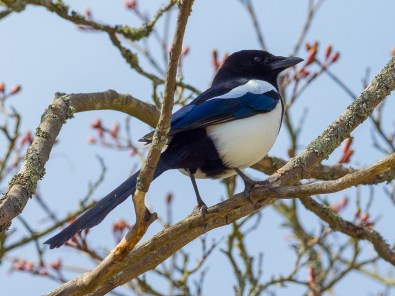
“What is that bird?!” a friend exclaims, peering out my window. It is the same question with all friends and family who visit from the east, the side of the country which magpies do not inhabit. I have to agree with them, the bird is rather striking with its long tail, blue wings, and smooth black head.  Part of its mystique is lost when it flies away, inelegantly stretching out its large white feathers on the tip of its wing, giving the appearance of flapping fingers.  “It’s a magpie. They are kind of pests, really,” I tell my friend. “But they are beautiful.”

***

There is great responsibility in choosing a name for a child, and also none at all. They will define the moniker, not the other way around. We will yell their names when it is time to leave the park, whisper them softly as we say good night, and shake our heads and say their names, laughing, as we look at our partners when the child misbehaves in a way that is oh so typical of himself.

My sons are wild birds, creatures I cannot begin to understand with spirits I cannot hope to harness. I have known them since they first existed, but as I try to comprehend their personalities, they slip away, changing and evolving again. Sweet babies turn into rowdy toddlers, and then into little kids with minds of their own. Soon they will be busy school children and teenagers who will most likely refuse to go birding with me. But that is tomorrow. Today, they wear the names we have given them, designations chosen as remembrances of those who came before and prayers for what will follow after.

***

I don’t know why we try to name wild birds. They will most likely fly away before we have begun to understand them.

Together, my sons and I peer into the wild, hoping to find homes for the names that fill our tattered bird guides. A name will not divulge any secrets to us, it will not clue us in on the full story of what flies between the trees.  A name is only a beginning.