In the footprints of dinosaurs

The stomping grows louder and closer. The leaves of the forest are shaking, and a deep growl rumbles behind me. The tyrant lizard jumps onto my back and its claws wrap around me. The roar erupts again, crescendoing briefly before devolving into a fit of giggles. “I got you!” my dinosaur cries, rolling onto the floor, laughing in preparation for the impeding tickles.

My boys love dinosaurs.

The fascination with animals they will never meet is no mystery. It is the romance of the unknown, legends of grandeur, size and unfathomable power cloaked in the promise of reality. They were larger than life, larger than our timid imaginations, yet they were real. Dinosaurs ate from the tops of trees while my sons’ feet have rarely left the ground to climb into the branches. Their footsteps thundered; their presence was known. Whether or not they let out mighty roars is inconsequential to my sons who love to bellow like the beasts themselves.

One weekend when the sun shone and the snow remained at bay, we traveled across the same land the Tyrannosaurs did in search of a museum that housed their bones. We munched on donuts and stopped along windy roadsides for urgent business. We arrived and the boys proudly sported fossil stickers on their shirt to prove their admission. Finally they saw it – bones stacked on top of bones. Hours upon hours of meticulous work, dug, cleaned, preserved, and oh so carefully pieced together. They stared at millions of years of history that had been brushed aside to unearth a single being, a life memorialized into an age it could have never believed. It towered above them, lifetimes upon lifetimes, epochs upon epochs above them. The Tyrannosaurus Rex, the king of every boy’s imagination, loomed large in its reality.

“Pat-saur! Pat-saur!” my youngest yelled over and over, in hopes that I would free him from the confines of his crib, trading the imprisonment of naptime for another reading of the library book on Apatosaurs. Skeletonized figures cover my sons’ t-shirts captioned with names that cause their tongues to trip. Ankylosaur, Diplodocus, Spinosaurus, Pteranadon. Tiny plastic recreations of their bodies are clutched by jelly covered fingers and carried as entertainment on boring errands. We eat our sandwiches and my oldest son asks if we are herbivores or carnivores. He asks me to tell him about the big meteor, to explain what extinction means, to answer the question of death.

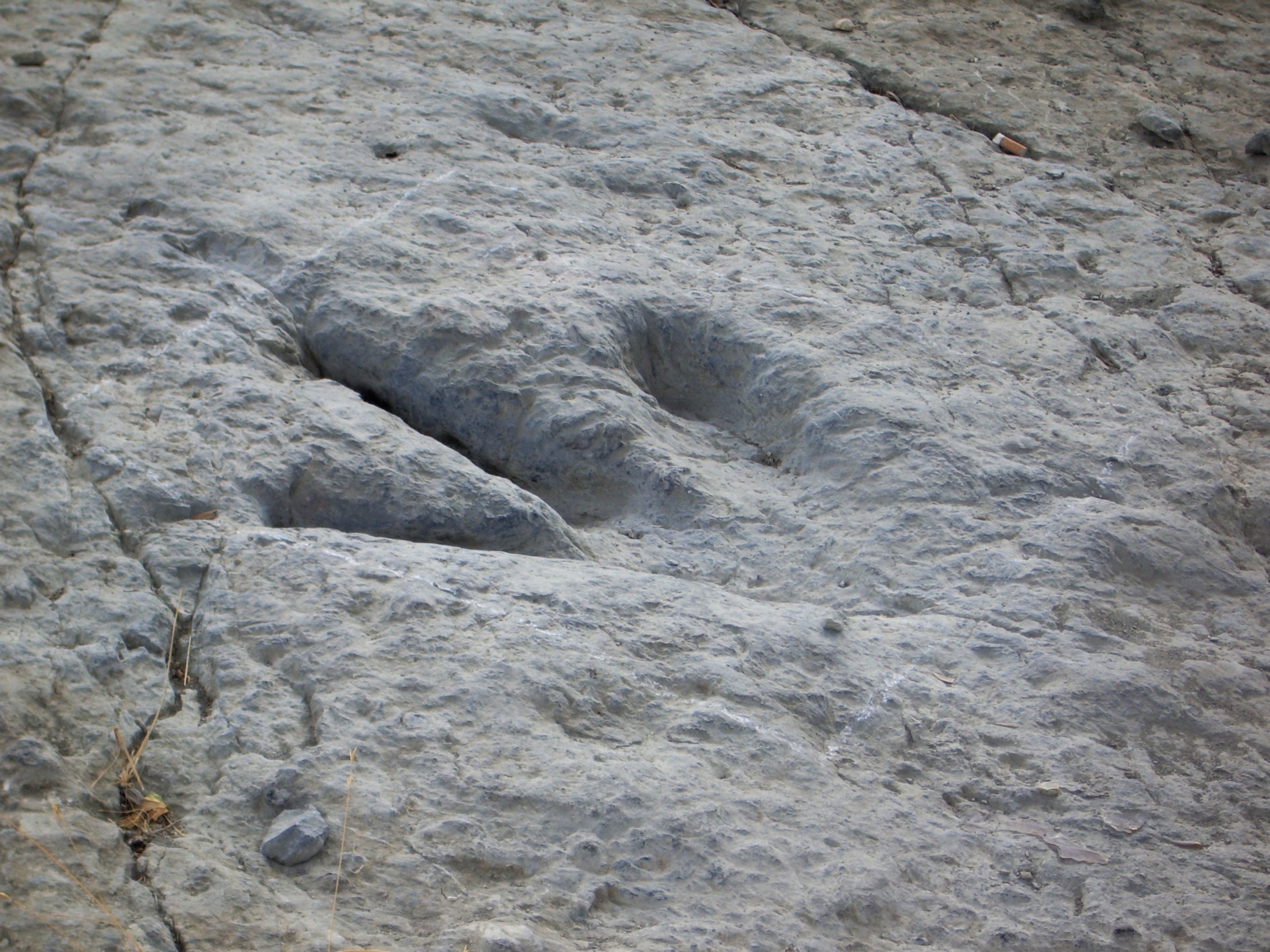
In the library, there is a mold of a Maisaura foot print. The boys briefly run their hands over it before bounding off for storytime. I pause a moment longer, feeling the bumpy stone for myself. These enormous beings have evaporated in time, living on in scientific journals, Hollywood, and the imaginations of young children. They left behind bones to be rebuilt and stared at in wonder. They gave us footprints, their weight leaving behind something real.

Maisaura means good mother, as paleontologists believe they took care of their young still in nests. I have one job now, to leave behind something real. The world is quickly moving and much of what I say and do, feel and believe, will roll off of it as it spins. My body will crumble and fade away. The impressions I leave will not be preserved in mud turned to stone, but in my children. They will carry my legacy, eventually turning it into their own to leave behind.

I understand why my children ran past the fossil in the library. There is no grand statue to stare up at in wonder, no bones of enormous size at which to gaze. I do not need the world to remember me, but I hope to leave it changed, for my existence to leave behind something real. The bones of the Maisaura have disappeared, but her footprint remains.
A Minor Faith

imageThe notes of the cantor’s dark and haunting songs call out this time of year, resonating through the gray and barren landscape. The minor chords ring through the chilling winds, fall down with cool rain drops, and my heart beats in response. It is a time of darkness, when the ease of spring is held at bay by the melancholy of the slow thaw. It is in these moments, I believe the deepest.

I have a minor faith.

My faith is small, stretched thin like the skin on a timpani drum, resonating when struck. It is real, engrained through muscle memory; years of standing, kneeling, singing, responding, have carved a home deep within my heart for faith to reside. Doubt has made its residence there as well, and the two have become close companions, an odd couple that govern my minor faith.

With belief comes answers, but more questions still. I have seen no more pain than anyone in this world, but have lived it just the same. I have watched a grown man cry, left homeless by the world and forgotten on a sidewalk. I have seen flies buzz around a baby’s head, no mother left alive to shoo them away. I have felt my own body fail me time and again, and baptized my children through the tears that fell on their heads as I waited for the heavy fog of early motherhood to part and set me free. My faith provides little answers to these unformed questions, but in these moments, only it makes sense.

In school my loves were anthropology and religion, as I was fascinated by the multitude of answers we have created to the same questions, questions that have vibrated through generations since humans first walked the earth. Who are we. Where did we come from. Where are we going. We have quenched the thirst these questions create with food, bread grown from dirt, with prayers shouted from mountaintops and whispered in hearts, with songs that shout joy, and songs that taste more bitter than sweet. Nevertheless, the thirst remains, and the thirst is my answer.

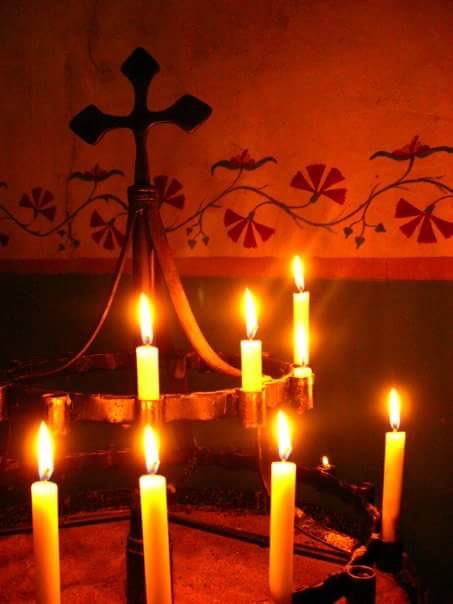
I believe. I believe in one God, and in bread broken, eaten with strangers sharing soup suppers in church basements. I believe in wine, in bottles passed between friends and spilled in laughter. I believe in songs sung in minor chords, candles that shine in dark moments, and a faith too vast for answers to be so easily found. I believe in the symbols, and in the questions which they answer.

Faith takes its place in this minor chord, singing softly between hope and love, notes I can hit more easily. My faith is not the greatest of these or of anyone’s, but it is my own. I will continue to  give it a home and find mine in it, whether I have more questions than answers, whether the world houses more pain than relief. It is my center.

I have a grand and minor faith.

My House

My house is covered in a fine layer of baby socks and matchbox cars. The baseboards are trimmed with dust and graham cracker crumbs. Well used pacifiers have crawled away behind dressers and under beds to rest in their retirement. Books lounge on the floor in front of bookshelves. Stacks of magazines that will never be read and bills that will eventually be paid are climbing towards the ceiling. Last week’s menu plan has dripped in the fridge – pasta sauce, split pea soup, beef au jus.

My house is not clean.

I don’t know how the housewives of the fifties did it, keeping houses clean, children fed, and husbands cocktailed, all while sporting heels, pearls, and manicured nails. I barely have time to cut my nails and the last time I wore heels was my wedding day.

According to people who study this kind of thing, women today spend more time with their children and less time on housework than women of previous generations. I want to know how. The boys and I do get lots of quality time together – going for walks, playing at the children’s museum, everybody staring at me while I sit on the toilet. But other than these special moments, I feel like a good chunk of my day is spent begging them to please, please, please go play in another room for five minutes so I can wipe applesauce off of the kitchen floor.

I really want to know how they did it. Maybe they did it after the kids went to sleep. Netflix streaming had not been invented, so it seems plausible. But worse. So much worse.

People love to tell parents of newborns not to worry about housework, to enjoy the snuggles and let the dust bunnies multiply like rabbits. We loosely followed this advice after my second was born, until we ended up with an infestation of fruit flies. It’s not practical guidance anyway, invading armies of tiny creatures or not. It won’t take long for a newborn to spit up on every article of clothing that you both own, and snuggles just aren’t effective at getting the spoiled milk smell out.

By the time people stop telling you things like, “Don’t worry about vacuuming! Babies grow up so fast,” they have turned into children who are actually capable of making their own messes, transporting toys from the toy box to the floor, and eating food that produces crumbs. I’m now supposed to have an immaculate, or even just tidy, well at least sanitary, house at the same time a tornado descends upon it.

I’m revising the advice we give to parents of young children. If you have a dishwasher, unload it once a day. Do a load of laundry most (or some) days of the week, and immediately put away the pieces you don’t want your toddler to drag around the house in case your in-laws stop by. Keep the walkway relatively clear of toys lest the FedEx man sue you. And don’t worry about the rest. Toddlers grow up fast too. Well, I’m assuming that’s true. But I do know they move fast, faster than me, so there is really no point in trying anything more.

Mud and Bread

My children are made of mud and bread.

The mud creeps up their knees, caking shoes and enveloping fingers. Dirt may be inviting to children, but mud is a calling. It is wrong and it is wonderful; it is a nightmare and it is heaven. In mud, destruction and creation are married. In mud, my children play.

They splash and drops land on their noses. They fling it back and forth, shouting and giggling. Children are made to play, to explore, to fall, to fail. They are meant to change, to grow, to redirect, to try once more. Children are meant for mud.

The bath is long and in the midday. The mud has hidden itself, unashamed of its wrongdoing, yet wanting to escape the forthcoming and punishment. I eek it out of ears, hair, noses and it heads down the drain, rejoining its rightful spot on the earth. My children are scrubbed pink again. Bathed in dirt, they become alive. Bathed in water, they become tired, heads heading heavily towards pillows.

In hours, they will awake again, hungry from adventure, hungry for food. I mix flour and water, salt and yeast, watching the pale muck and mire transform into sustenance.  The loaf rests on the counter, pallid and unattractive. Three light slashes from the knife across the top and it has room to rise and grow. In fire, it will harden and be made beautiful. At the table it will be broken and shared, sustaining the lives I once created.

They wake, and demand pieces of crust to be gnawed on and ultimately abandoned behind couch cushions.

Mud and bread. It is the process of creation we witness daily. Life becomes death and death becomes life. Children splash in puddles and grow in and out of mud. Messes become memories and bread is made, eaten, and forgotten. This is the ashes to ashes and dust to dust. We are made of mud and bread.


On the question of why

image

I wish I had paid more attention in eighth grade earth science class. I was pretty convinced my teacher was wrong at the time; I would never need to know what a cold front had to do with the creation of wind, or how the moon’s gravity affected the tides. Surely the practice of teaching children nomenclature and the classification of creatures was simply an exercise in tedium, meant to keep us stationary in desks until we reached the age of eighteen and could be released into the wild.

 “Mama, why is it snowing?” my three year old asks. I really should have paid more attention in class.

“Well, honey, because it’s cold, and when it’s cold out, it doesn’t rain, it snows,” I reply, feeling that should be sufficient.

“But why? Why does it not rain? Why does it snow?” Foiled again.

I rack my brain. I don’t mind the questions. Part of me enjoys the exercise, seeing if it is possible to reach into the deep recesses of my brain and see if I can dust off anything I accidentally kept from those middle school classes. Another part of me enjoys that he is old enough for conversation, a break from the long quiet days with an infant, with only the sound of my own voice and his laughs to pass the time. But it is becoming increasingly rare that I actually know the answer.

“I don’t know honey,” I reply. This has not been an acceptable answer for at least the last six months, but I give it a shot anyway.

A higher pitched voice joins the chorus, and the younger brother throws in his own “Why?” Growing up next to a curious toddler has caused the little one to enter into the “why?” stage prematurely, assuming it is the acceptable response to any declaratory statement. Now they both interrogate me, giggling between their yelps of, “why?”

I try again. “Well, everything is made out of molecules. Or atoms, or uh, little things, well, anyway, when the air gets really cold it’s hard to move. So the little drops of water get really cold and stop moving and freeze together and form crystalline structures called snowflakes, and then those accumulate in clouds and when there is enough of them, or maybe when there is a cold front, or wind, or, well, anyway they start to fall out of the clouds onto the ground and that’s called snow.” I wonder if any of what I am saying is even remotely accurate. At least its sounds pseudo-scientific. Language development is the benefit of these conversations, I convince myself, and not actual scientific knowledge.

Perhaps I should have taken a class on the geosciences in college. Eighteen year old me would have scoffed at the idea of choosing a class that would help me be a better stay-at-home mother. If only my sons would ask me to extemporize on things like the influence of political economy on the development of critical medical anthropology, then I could put my education to use and answer effectively.

“Why?” they chorus together.

The questions are constant. Why is it sunny today, why do birds fly, why do dogs have fur, why does bread rise, why do astronauts fly to the moon, why is there no gravity in space, why can’t I have cookies before dinner, why do we ride in car seats, why is that tree so tall?

To them, the world is fascinating, it is shiny and new and, if one only asks the right questions, it will become understandable. For me, it is ancient and well-traveled, and ultimately unexplainable. The crevices of time have cracked the earth and have been filled with more questions than answers. I have not travelled much of the world, but enough to learn that there is much I do not know.

My boys do not believe this. To them, I am their mother, the storehouse of all answers. And so they call to me, unendingly, asking why, over and over again. They will soon learn that I do not hold the answers they are looking for, and strike out on their own. I hope they find what they are looking for, but more than anything, I hope they fall in love with the search.

Pie and Gratitude

pie-time-1514936-639x489

“Psst, let’s go have a pie date,” I said. His eyes grew wide, as any two year old’s would at the mention of dessert before it was even noon. It is rare I get one on one time with my oldest during holiday gatherings, and I figured I could lure him away from the extend family for a few moments with the promise of leftover Thanksgiving sweets. I plated the last two tiny slivers of pie, the pieces that had been left behind because no one else had wanted to be guilty of taking the last bites. I topped mine with whipped cream, and headed over to the kids table where he was anxiously waiting.

He looked at his plate, and looked at mine. His eyes fell, his head hung, and his fork went untouched.

“What’s wrong, honey?” I asked, surprised.

“I don’t want to tell you,” he replied quietly.

I looked down at my plate, piled high with whipped cream. “Is it the whipped cream?” I quickly scraped it off.

He looked up, smiled and dug in.

My son is allergic to dairy. We’ve known that since we took him on a ten hour round trip to see a pediatric gastroenterologist, pulling over so that he could throw up on the side of the road, just like he had done for the last six months. He is also allergic to peanuts and nuts, which we’ve known since we took him to the ER on New Year’s Day, and then again several months later. He had always been perfectly content to eat his dairy-free meals alongside our dairy-filled ones, until now. My heart shattered watching his face fall. If anyone wanted to protect him from pain, it was me; and if anyone was to know how he felt, it should have been me.

It’s awkward to talk about in polite company, but I have a bladder disorder that necessitates a strict diet avoiding any acidic or irritating foods. It’s a long list, including but not limited to: chocolate, alcohol, coffee, tea, soda, fruits, tomatoes, spicy foods, sour foods – in short, all of the things that taste good. Dairy and peanuts, however, were not on the list and after the resurgence of my disorder in recent months, the foods we are all able to eat together as a family has become increasingly limited. Dinnertimes at our household feature a short and steady rotation of monochromatic meat, vegetables, and grains.

“How can you live like that? I would just die if it were me,” people used to tell me when I was first diagnosed. It stung. I watched my friends down beers at the local breweries, and munched awkwardly on popcorn instead. I struggled to stay awake in grad school classes without my morning cup of coffee. I felt guilty about the life for which I had unwittingly signed up my brand new husband. The diet helped and the pain I had been experiencing for years began to subside. The pain of living a life without my favorite foods lingered, however. Food is ritual – the Christmas Eve hot chocolate, the bottle of wine to celebrate our wedding anniversary, the lasagna my mother used to cook for me on my birthday. Losing the rituals was the hardest part for me.

Often I hope that medicine advances and one day my son and I together can dig into a hot fudge ice cream sundae, topped with peanuts, cherries and sprinkles galore. I picture being able to send him to school with a peanut butter and jelly sandwich in his lunch bag, and then meeting a friend for a cup of coffee. Whenever I see families dining together in restaurants, enjoying summer afternoons at the ice cream store, or grocery shopping without stopping to read every label, I wonder if they know how lucky they are.

Of course they don’t.

And neither do I.

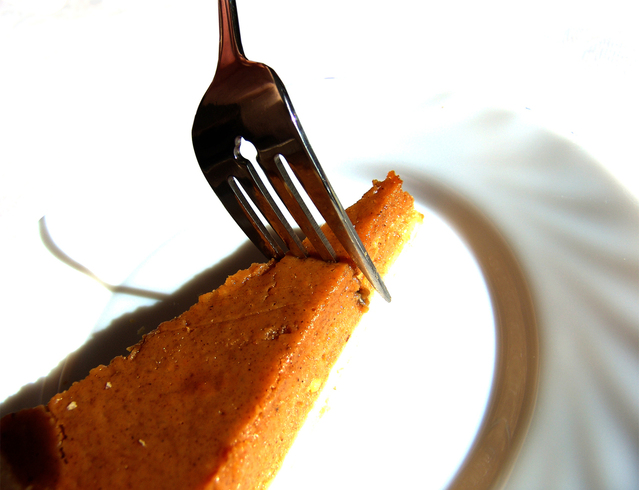
My son is kicking his legs back and forth underneath the table, bouncing up and down and eating the (dairy-free) crust off his pumpkin pie. I smile to myself, thinking he must take after his Dad, as I had eaten the pumpkin and left the crust.

It’s impossible for any of us to understand how lucky we are. It had never occurred to me to be grateful for chocolate ice cream, spaghetti and meatballs, or lemonade until I was told I couldn’t eat them anymore.  And now I realize that there are so many things for which I should be grateful. There are the obvious – that my son is here with me to share a piece of pie with, or that despite our limitations, we have never wanted for food enough to eat. Then there are the ones that are not so obvious, all of the things that I would only realize I loved and was grateful for after they were taken away. My list of gratitude would be long if only I knew where to begin.

I’m not glad this happened. I would much rather not carry an epi pen, or have never made my kid cry in the grocery store because I yelled at him for eating a piece of candy without asking, than have learned a valuable life lesson. But a life full of tedious dietary restrictions has happened, and I am grateful to have found something worthwhile in it.

We finish our pie, and my son runs off back to grandparents, aunts, and uncles, the sugar making him dance around the room. His little brother bounces along with him. Now I understand that my life is full of things to be grateful for, things I still don’t even realize I should appreciate. Watching them play, I do know what comes first on that list. Them.

How to buy underwear at Target, in 7 steps

Here is how to buy underwear from Target in three hours or more, with only seven simple steps.

  1. Decide you need underwear. One simple errand which shouldn’t take that long. Kids might like doing something different this morning anyway. They are probably bored of playing with toys, right? That’s only fun for so long.
  2. Debate if you can use the baby gift card you just found in a drawer on something for yourself. You’ve definitely spent that amount on diapers several hundred times over since the baby shower two years ago. And let’s be honest, the babies are the reason none of your clothes fit anyway.
  3. Drive to Target. I mean, wait, no, not yet. Baby is rubbing his eyes. Okay, we will do a nap first. Put on an episode of Thomas the Train for the toddler. Put on a different episode of Thomas the Train because the first was scary. Get baby down for nap. Sit on the couch beside your toddler while baby sleeps and look for coupons for underwear on your phone. Wonder if there will ever be a point where you don’t need to look at coupons for underwear.
  4. Get ready to drive to Target, for real this time. Pack the contingencies – water, snacks hidden in secret compartments in the diaper bag so they won’t find them until you decide bribery is the only way you will get them in their car seats. Look for matching socks. Look for any socks, matching or not. Put on coats. Calmly ask, “would you please come here so I can get your boots on?” Try to think of threats you can use if he doesn’t come here by the count of three, since “or we won’t go to Target” is really more of a reward. Result to bribing with Grandma’s cookies before you even leave the house. Find hats. Find keys. Put shoes back on children who have learned to take them off. Open doors, start the car, chase one child down the sidewalk. Return to car. Buckle in. Scrape off snow. Drive off.
  5. While driving, remember the days when buying underwear would not be considered the thing you did that day. It would just be a thing you did that day, on your way to doing other more interesting things. Debate buying your underwear on Amazon from now on.
  6. Arrive at Target. Unbuckle one child. Unbuckle second child while attempting to keep first child by your side. Enter store. Wonder why shopping carts don’t have seats for two children. Meticulously plan route around store to avoid the toy aisle. Promptly walk past child holding a toy. Spend the next thirty minutes saying, “no, we did not come here for toys.” Take out your phone. Record yourself saying, “Please do not touch that. No, we do not need that. Please do not put things in the cart without asking me. Please stop asking me.” Play it on repeat. Abandon one child in cart while chasing another child down the aisle. Buy underwear.
  7. Begin to leave Target. Return items your children accidentally stole to customer service. On your way out, notice the cart with two seats in it. Attempt to carry bags and children over the snow and ice. Chase children down in parking lot. Attempt your best loving but firm voice while saying, “you MAY NOT run off and get yourself killed.” Drive home. Attempt to console crying hungry children. Vow never to return.

Moments

It’s my favorite part of the day.

I sneak in to my oldest son’s room to “check” on him. He is fine, of course, and that is not why I am there. I tuck his blankets back around him and smile at how much younger he looks when he sleeps. Some nights, his legs flail off the bed and his well-loved stuffed monkey stares up at me from his arms, agreeing to take the night shift with him. Other nights, his knees are tucked under his chest, his bum high in the air, just as he did when he was a baby. My youngest is a light sleeper, one who wakes at even the thought of someone dropping a hat and so instead, I stand at the door, listening for his breath.

They are quiet, still and peaceful, and so unlike their wild daytime personas. These are the moments I cherish and hold dear, the soft sweet ones that come at night.

Because they are not all like that.

It is tempting to think, as I stare at them sleeping, “this is what makes it all worthwhile.” But the moments of parenthood do not subscribe to a particular formula, a summation of the good moments less the difficult ones, multiplied by the number of children divided by the hardships, the numbers crunching until you arrive at a baby softly snoring in his sleep.

You live them all. The ones where you fret over their safe arrival, the ones where they wrench from your body. The ones in the middle of the night where you cry over a not-sleeping baby who refuses to do so and you wonder if you can last another moment like this. The ones where you stare at your body and wonder if you will ever find who you once were in there. There are moments when you are surrounded by screams for food, hugs, and clean diapers, screams more dramatic than the situation warrants and you simply wish you could add your own to the chorus. There are the days when you realize you haven’t cleaned your shower in three months and others when you start looking at airplane tickets to Tahiti. There are moments the boredom of folding, wiping, singing, reading, picking up, putting down, changing, weighs down heavy on you and in the long stretches of loneliness you wonder, “was this the right choice?”

These moments, as I am led to suspect by every elderly woman in the grocery store who has reminded me to cherish them, are the ones that slip from our memory, a few fading every time our children outgrow another pair of shoes. They fade, and we cherish the sweet ones. Sticky kisses and outrageous giggles, pancake breakfasts long walks on Sunday evenings, first smiles and first steps, unsolicited hugs and morning cuddles are what earn the rightful spot in the forefront of our memory.

Nonetheless, you live them all. The good do not cancel out the bad, and instead work together to carve into your heart the heavy beauty of parenting. But in the quiet moments of the night you can rest easy in the goodness of a sleeping child, however fleeting it may be.

The Sitting Days


These are the sitting days.

The gray sky hangs low, a heavy blanket sitting just above the houses. The world has hushed, and the hum of the holidays has faded back into picture frames and boxes, tucked away for another year.

This is the time of quiet, of stillness, of slow patience. Tree branches draped in thick sweaters knit of snow hang heavy towards the ground. Pots of soup are stirred night after night. Mugs of tea and coffee and cocoa are tightly held by fingers hoping to capture their warmth. The snow has lost its luster, aging from wonderment to a chilling gray. Wool blankets are tucked under chins, and their occupants sit staring at dancing fires, waiting.

These are the sitting days.

The cold demands more tea, which calls for fresh bread, which requests homemade jam. I pull a jar of blueberry jam out of the freezer. It tastes like sweet summer afternoons, the ones where the sunshine seeps into the house and throws itself across the rooms, insisting on being adored. I mashed fresh berries and sugars together on one of those afternoons, wearing a yellow apron rimmed with flowers. The jam itself is simple, but having it makes me feel like I truly am the kind of woman who wears flower covered aprons and puts food in jars while someone strums a banjo on the front porch and waves at passersby. It makes me think of simpler times. I don’t think there really ever was such a thing as simpler times. I believe that times are hard and have always been hard, and we would rather not remember that. But I do believe that there were days with sunshine and fresh berries. Days where jam was put up for the winter.

Today, the city is gray and silent. The roads and the trails are covered in ice. The tracks in the snow are few and frozen, and they do not include our own. We remain tucked under wool blankets, waiting for the gray to pass.

Montana summer days drag well on into the nights. After dinner was finished, we headed outside, letting babies fall asleep on our backs as we walked. Up and down our streets, waving at neighbors. Over the hills behind our house, staring at the city below, watching the sun lazily make its way towards the mountains. We walked until we had passed bedtimes, figuring they weren’t as important as fresh air. We left dishes until later, knowing come winter, we would regret having wasted a moment of sun. I wanted to soak it all inside me, to put up sunshine for the cold winter nights I would need it most.

It is night now, and the soft gray has turned to black. Tomorrow the dim light will peek above the eastern range and stretch a little longer before heading to bed once more. We will wait with patience and jam, hoping it will decide to join us again soon.

The adventurer

oceanWe are at the ocean, and the ocean is behaving exactly as it should when you go to visit it. It is brilliant blue and stretching for endless days, with a lace of bright white waving at the edges. The sun shines down and the waves glisten back in a silent call and response.

It is the start of a new year.

Wild things belong outside, and accordingly, my children love being at the beach. The oldest boy has twin interests – construction and destruction, and sand and the castles which grow out of it provide him endless opportunities for both. Before him his the perfect canvas – he can build, he can draw, he can dig, and most importantly, he can stomp, smash, and be as perfectly messy as he wants without his mother careening around the corner to put an end to the rowdy fun. Fun of the loud and dirty variety seems to be both the type most preferred by children as well as the type that mothers’ have the greatest problem with, but the beach allows for a peaceful compromise.

My youngest heads directly for the water. He is dressed in multiple coats, mittens, and a wool hat – it is far too cold for swimming. He marches straight ahead, as fast as little legs will go. His mission is typically in vain, as a watchful relative will quickly scoop him up and return him to dry sand before the waves can wet his boots. If the conditions are right, the ocean will push bubbles towards him, and he will rush to stomp on as many as he can before the water returns for them moments later.

I’m curious what draws him to the water. Perhaps he is convinced if he can only give his parents the slip long enough, he will be able to finally stick his mittens in the water and see what all the fuss is about. Or maybe he is captivated by the same mystery that causes us all to turn and stare at the ocean whenever we see it. The unfathomable grandeur calls him forth.

He is too little to understand the enormity of what is before him, and too young to know that he is not yet old enough to appreciate all it has to offer. He senses challenge, and runs toward it, not away. It is the nature of young children. They see rocks twice their size and climb onto them. They see puddles deeper than their knees and jump into them. One time my husband and I took our children on a walk along the hills behind our house, hoping to take advantage of the long summer evenings. We wandered to the base of a sizable hill that overlooked the city, and jokingly dared our two year old to see how far up it he could go. He set off, head down, hands pumping by his side, resolutely marching even after our own legs burned and breath became shortened by the incline. He made it to the top, sweaty and unawed, unlike his parents in the latter. He  stood on a rock and called out below, “I see the land of Helena!” Surprise and a smile only creeped across his face when he saw his parents giggling at his proclamation.

The ocean calls to my little one, who has yet to believe us that he is too little and the water is too cold to sit in it, splash in it, and yes, even to swim in it. He heads toward it anyway.

It is the start of a new year.

May you be too small to know that you are not big enough.